How to Qualify Sales Leads Without Wasting Sales Time

Only 13% of marketing-qualified leads become sales-qualified leads, leaving 87% that fail basic sales qualification. At the same time, only about 25% of marketing-generated leads are ready for direct sales engagement when captured, while 79% never convert into sales. These benchmarks, reported in lead qualification statistics from Landbase, point to an uncomfortable truth for small businesses: collecting more names won't fix a weak pipeline. Your team needs a fast way to identify fit, intent, and timing before a salesperson spends time on the phone.
That matters even more for electricians, plumbers, clinics, law firms, contractors, and solo professionals. An inbound call can be a strong buying signal, but it can also be a wrong number, a competitor, a bot, or someone outside your service area. Good qualification protects sales capacity without making legitimate callers feel interrogated. AI can handle routine questions, language detection, and initial triage, while a human takes over when judgment, empathy, or technical expertise matters.
Why Most Leads Never Deserve a Sales Call
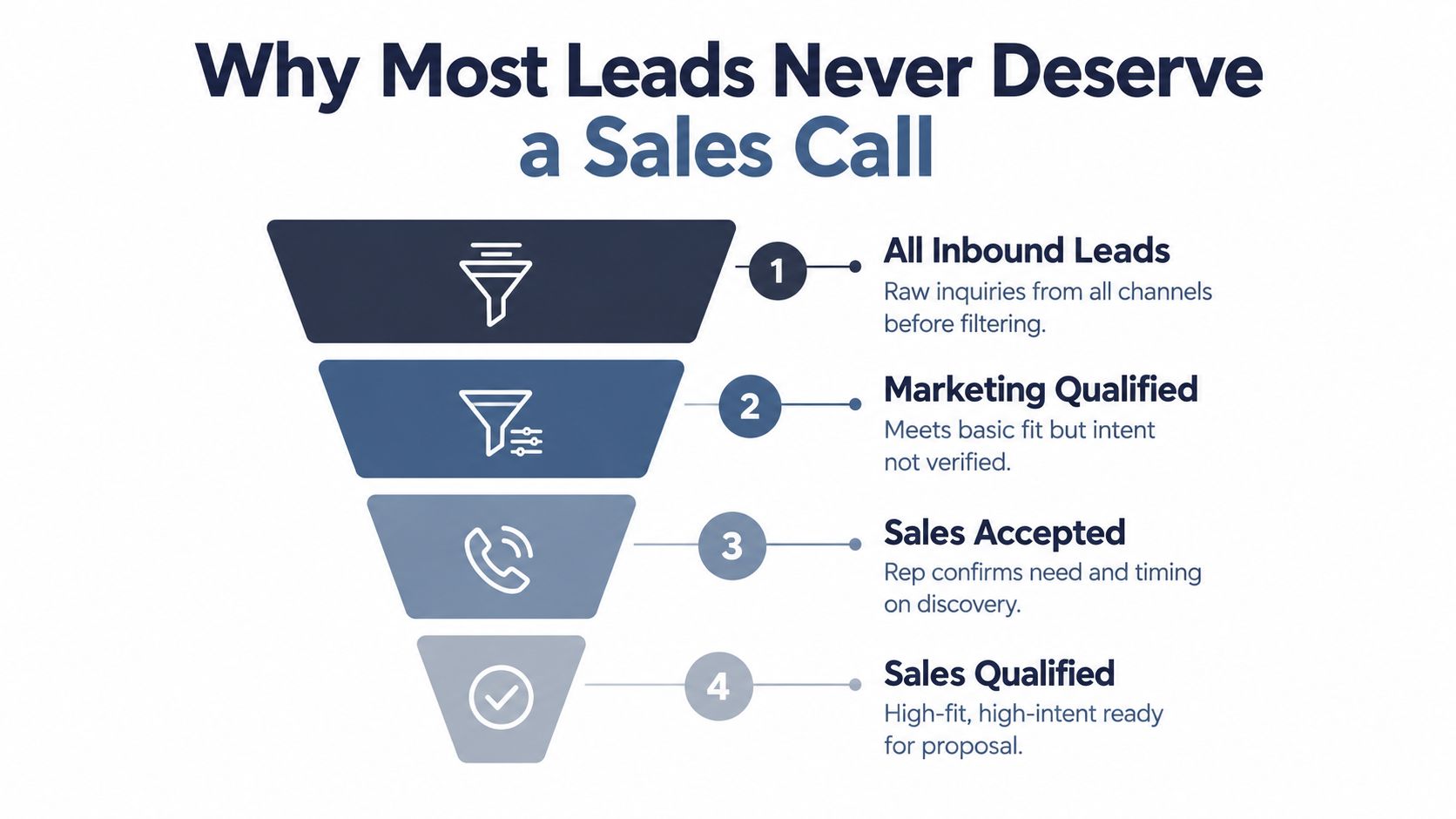
A raw inquiry isn't a qualified opportunity. It might contain a name and phone number, but it doesn't yet prove that the caller matches your customer profile, has a relevant problem, can buy, or needs help within a useful timeframe. A sales-qualified lead has passed those practical tests and is ready for a focused sales conversation.
The MQL-to-SQL gap exists because marketing and sales often use different definitions of quality. Marketing may count a form submission, content interaction, or contact request as promising. Sales needs evidence that the person has a real need, belongs to a serviceable account, and can move toward a decision. If those definitions aren't aligned, representatives spend their days investigating contacts that should have been nurtured, redirected, or declined.
Qualification is a capacity decision
Sales time is limited, especially when the same person answers calls, visits job sites, sends estimates, and manages existing customers. Qualification creates a decision boundary:
- Accept: The lead fits your service, location, customer type, and likely value.
- Nurture: The need is plausible, but timing or readiness is unclear.
- Route elsewhere: The request belongs with another team, location, or specialist.
- Disqualify: The contact is outside your rules, lacks a relevant need, or shows no credible buying path.
Strict filtering doesn't automatically damage caller experience. Poor communication does. A caller should receive a concise explanation, a useful alternative, or a clear next step rather than being pushed through a long script that doesn't apply to them. AI is useful at this stage because it can ask consistent screening questions in the caller's language and transfer unusual or sensitive cases to a person.
Practical rule: Qualify the opportunity, not the caller's enthusiasm. A chatty contact with no need is weaker than a concise caller who has a defined problem and a realistic timeline.
Response time also changes qualification quality. Companies contacting new leads within five minutes can be around 21 times more likely to qualify those leads than teams waiting 30 minutes or longer, and qualification success can drop sharply once the response takes more than five minutes, according to sales qualification guidance from SalesHive. A phone-first process therefore starts before discovery. It identifies the reason for contact, confirms basic fit, and gets a qualified person to the right human while the buying intent is still active.
For a deeper call-screening structure, use this guide to screening a call. The useful outcome isn't a larger list of MQLs. It's a cleaner queue of conversations that deserve expert attention.
Define Your Ideal Customer Before You Qualify Anyone
Qualification fails before the first question when the business hasn't defined who it serves well. Your Ideal Customer Profile, or ICP, describes the type of account that gets the most value from your service and can be served profitably. For an SMB, that definition should be operational enough for a receptionist, dispatcher, salesperson, or AI assistant to apply consistently.
Start with the account, not the contact. Write down the industries, company sizes, locations, job types, project categories, and service conditions that fit. A commercial electrician might prioritize property managers and facility owners within a fast-response area. A dental practice might distinguish new-patient appointment requests from insurance questions or existing-patient administration. The exact criteria differ, but each business needs a visible first-pass filter.
Build a one-page fit filter
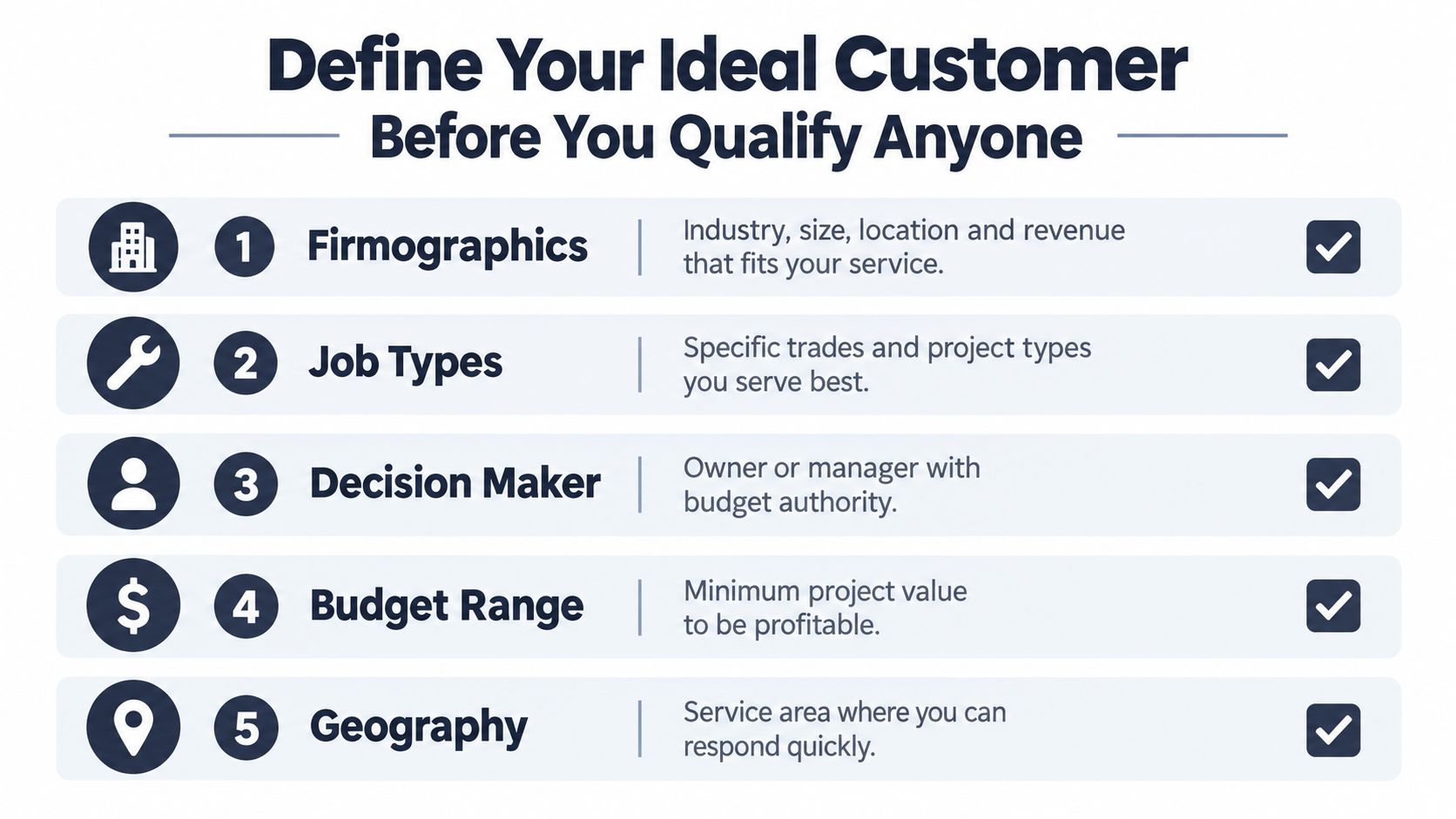
Use five categories and make every category answerable with information available from a form, call, or basic account lookup.
- Firmographics: Record the industry, organization type, size, location, and business characteristics that match your service.
- Job types: List the projects you handle best, then separate profitable work from requests you regularly refer out.
- Decision maker: Identify whether the contact is the owner, manager, property representative, patient, buyer, or another participant in the decision.
- Budget range: Set the minimum commercial threshold that makes the work worthwhile. You don't need to demand a precise figure on the first exchange, but you do need a way to identify obviously incompatible expectations.
- Geography: Define the locations where your team can respond reliably. A nearby caller and a technically suitable project may still be a poor lead if travel makes delivery unworkable.
Separate person signals from account signals
A contact can sound ready while the account is a bad fit. Conversely, an employee may ask an early research question for an account that has a strong service need and a clear purchasing process. Score both layers.
Person-level signals include the caller's stated problem, urgency, role, preferred contact method, and willingness to schedule. Account-level signals include industry, location, project type, operating scale, existing relationship, and the complexity of the buying group. This distinction prevents your team from overvaluing one enthusiastic contact.
Audit the last ninety days of conversations and inbound records, as recommended in AWS guidance for SMB AI customer service. Review calls, emails, chats, reviews, forms, billing records, orders, and scheduling data. Look for the language customers use, the requests that become jobs, and the questions that repeatedly consume staff time.
Turn that audit into explicit rules. For example, “serves our area” is too vague. “Service address falls within our active response area” can be answered. “Interested” is weak. “Needs an estimate for a defined project and wants to discuss scheduling” is actionable. This is the foundation for lead-scoring automation, because automation only improves decisions when the underlying rules reflect the business.
Choosing the Right Qualification Framework for Your Sales Motion
Frameworks are useful when they reduce guesswork. They become harmful when a short, transactional call is forced through an enterprise discovery process. Choose the lightest structure that captures the information needed for a reliable next step.
BANT covers budget, authority, need, and timeline. It works well when a prospect already understands the offering and the purchase requires a clear commercial decision. It can feel too rigid at the beginning of an inbound conversation, especially when the caller wants help with a problem before discussing money.
CHAMP starts with challenge, then considers authority, money, and prioritization. That ordering suits consultative conversations where the problem itself determines whether the opportunity is real. It gives representatives room to understand the situation before asking about budget, but it still requires a meaningful conversation.
MEDDIC adds metrics, economic buyer, decision criteria, decision process, pain identification, champion, and competition. It belongs in complex, higher-value deals with multiple stakeholders and formal approval steps. A trades business taking urgent residential calls shouldn't use it as a front-door script. A company selling into a complicated commercial account may need parts of it later in the opportunity.
| Framework | Best For | Key Questions | Watch Out |
|---|---|---|---|
| BANT | Clear purchases with visible commercial criteria | Can they buy, who decides, what problem exists, and when must it be solved? | Asking about budget before establishing relevance |
| CHAMP | Consultative SMB and service conversations | What challenge matters, who owns the decision, is money available, and is it prioritized? | Spending too long diagnosing low-fit requests |
| MEDDIC | Complex account sales with several stakeholders | What outcome matters, who approves, how is the decision made, and who supports the purchase internally? | Over-engineering fast inbound calls |
Match the framework to the motion
For a phone-led SMB motion, use a compact hybrid: fit first, then challenge, timing, authority, and commercial expectations. The representative doesn't need every framework field before booking a qualified appointment. They need enough information to decide whether the next action should be a transfer, site visit, estimate, nurture message, or polite disqualification.
Score intent more heavily than activity. A page visit, email open, or repeated content interaction can provide context, but it doesn't prove a buying event. Language such as “we need this repaired,” “we're replacing the current provider,” “we need an appointment,” or “can someone quote this project?” usually deserves more attention because it describes a problem and an action.
Account-level context matters just as much. A person may have authority but represent an account outside your geography. Another contact may lack final authority but work inside a strong-fit organization with a defined buying group. Modern qualification should capture both realities instead of reducing the lead to one contact score.
For teams formalizing the process, the benchmark data is sobering. Only 40% of firms consistently apply qualification criteria, and 44% use lead scoring, according to B2B lead qualification and nurturing benchmarks. A simple framework used consistently will outperform a complex framework that lives only in a training document.
Questions Scripts and Scoring That Reveal Real Intent
A qualifying call should sound like a useful conversation, not an examination. Ask one question at a time, explain why you need the answer when appropriate, and let the caller describe the problem in their own words. The first objective is to verify that a real opportunity exists.
Use questions that expose a next action
Start with an open question, then narrow the conversation:
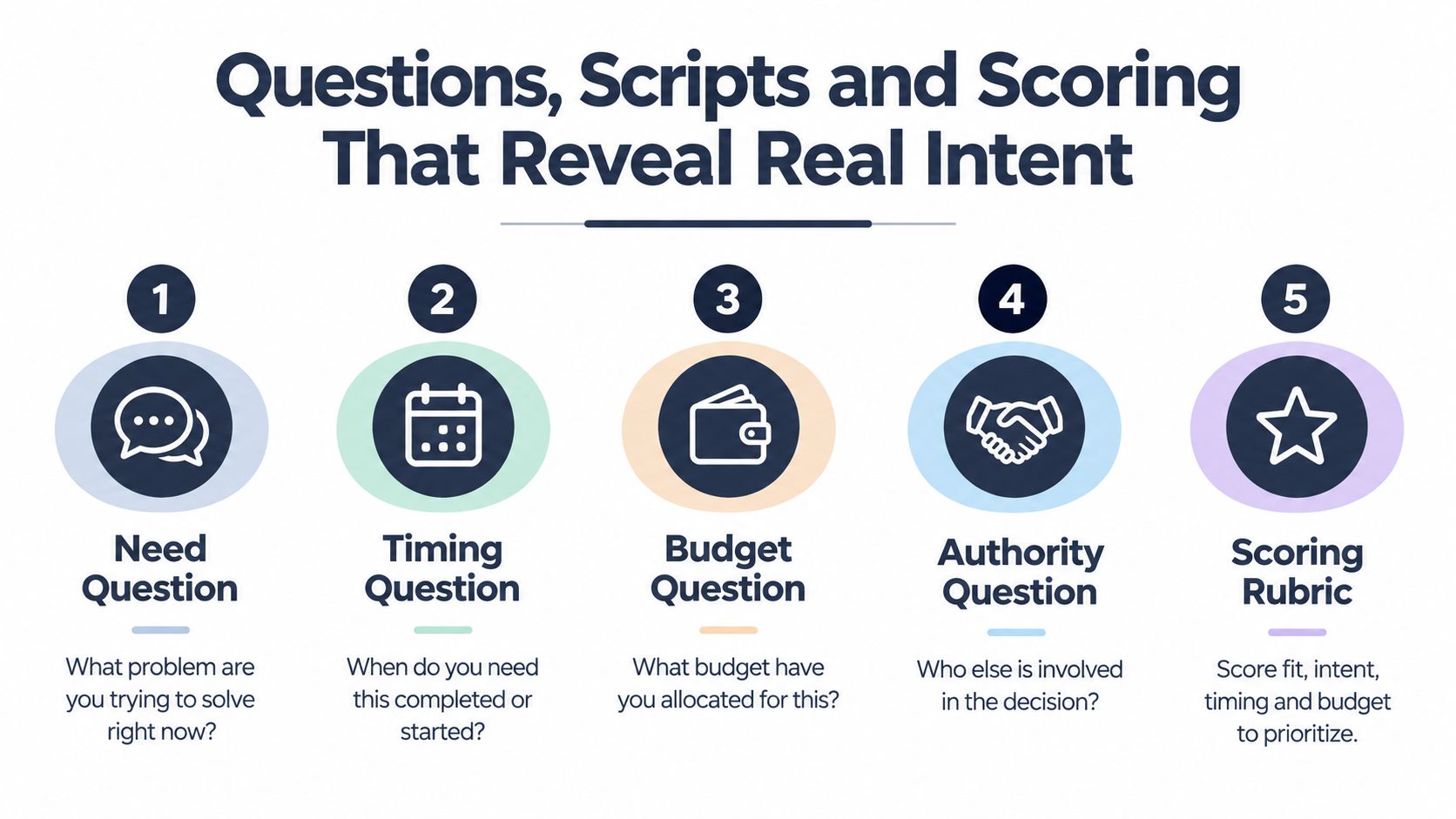
“What problem are you trying to solve right now?”
Follow with:
- Need: “What happened, and what would a satisfactory outcome look like?”
- Timing: “When do you need this completed or started?”
- Current situation: “Are you using someone else for this today?”
- Authority: “Who else needs to be involved before you can approve the work?”
- Commercial fit: “Have you set aside a budget, or are you still working out the likely cost?”
- Logistics: “What address or service location should we use?”
The order can change. An emergency plumbing call needs location and availability early. A planned commercial project may need scope and stakeholders first. The representative should collect the minimum information needed to make the next decision, not force every caller through identical wording.
A short phone script might sound like this:
“I can help route this correctly. Could you tell me what you need done, where the work is located, and when you'd like it handled? Once I understand that, I'll let you know the next available step.”
For chat, use a compressed version:
“I can help check whether we're a fit. What do you need, where are you located, and when do you need help?”
The difference between strong and weak questions is specificity.
Strong question: “What has to be true for you to choose a provider?” Weak question: “Are you interested in our services?”
The first produces decision information. The second invites a polite yes without revealing need, authority, or timing. A collection of practical customer service scripts can help staff keep the tone consistent while adapting the wording to the situation.
Use a transparent rubric
Keep the first version simple enough that a new team member can apply it without coaching. Score each category as 0, 1, or 2:
| Category | 0 points | 1 point | 2 points |
|---|---|---|---|
| Fit | Outside service or customer profile | Partially aligned | Strong account and service match |
| Intent | General information only | Problem is plausible but unclear | Defined need or direct buying request |
| Timing | No timeframe | Future or uncertain | Specific start, appointment, or decision window |
| Authority | No connection to decision | Influences the decision | Owns or directly controls next step |
| Source quality | Unverified or unsuitable inquiry | Known channel with limited context | Trusted source with clear request |
Set your acceptance threshold after reviewing actual outcomes. Don't assign points to every available activity signal because your system can track it. Sales-motion guidance highlights the need to consider the person and account together, including ICP match, buying committee complexity, and timing.
Your rubric should also include decay. A strong score from an old interaction shouldn't remain permanently strong. Reduce the weight of stale activity, refresh the criteria when close patterns change, and create a feedback loop between sales and marketing. If accepted leads rarely progress, the issue may be the threshold, source, question wording, or routing rule.
A strict process can disqualify 30% to 40% of inbound leads when they fail clear thresholds, according to recent inbound lead qualification guidance. Do it respectfully. Tell the caller what you can and can't handle, offer the next useful option where one exists, and avoid making the person repeat information to several employees.
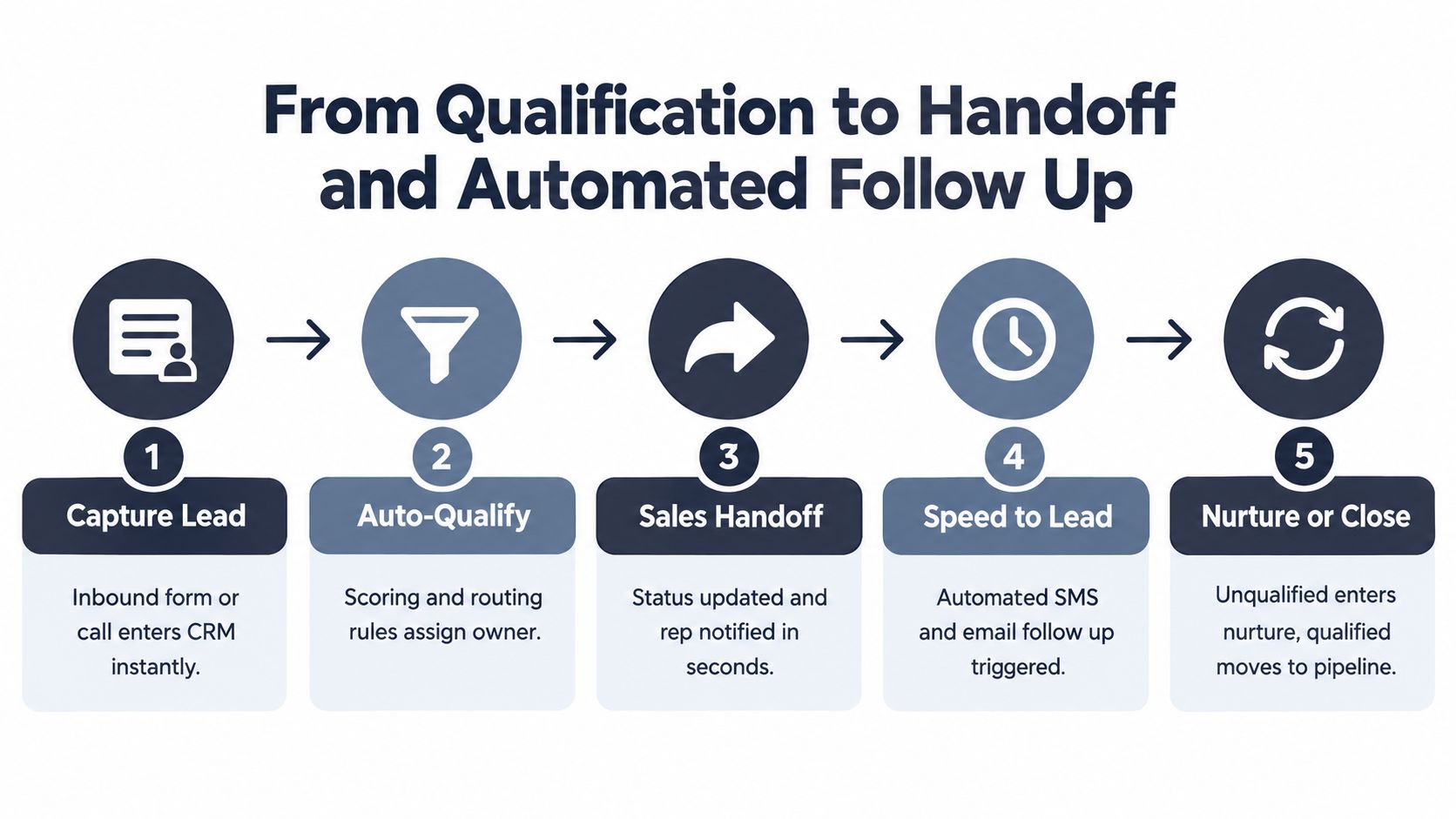
From Qualification to Handoff and Automated Follow Up
Qualification only creates value when the result reaches the right person quickly. A useful workflow moves one inbound contact through capture, screening, routing, follow-up, and status management without asking staff to copy details between systems.
Design the handoff around decisions
Create CRM fields that mirror the conversation:
- Contact record: Name, phone, email, preferred language, and permission for follow-up.
- Account fit: Industry, location, customer type, project category, and service-area status.
- Qualification details: Need, intent language, timing, authority, budget context, and source.
- Operational status: New, screening, accepted, assigned, booked, nurture, disqualified, or closed.
- Next action: Owner, deadline, appointment time, and any promised follow-up.
Routing should be equally explicit. A residential emergency may go to an on-call dispatcher. A commercial project may go to an estimator. A patient appointment should reach the relevant practice team, while an account outside the service area should receive a clear alternative rather than entering the sales queue.
The five-minute response benchmark makes this an operational priority. New inbound leads contacted within five minutes can be around 21 times more likely to qualify than those contacted after 30 minutes or longer, as reported in the earlier SalesHive qualification source. The exact workflow can vary, but the principle is stable: capture answers immediately, notify the owner, and trigger a useful acknowledgment when a human isn't available.
Start with one repetitive task
Don't begin by automating every customer interaction. Choose one high-volume, conversion-adjacent task:
1. Answer routine FAQs about availability, service areas, pricing approach, or preparation. 2. Schedule appointments using the business calendar and defined availability. 3. Triage requests by job type, urgency, location, and customer status. 4. Send acknowledgments that confirm the request and explain what happens next.
A phased rollout lets the team compare first-response time, repeat contacts, missed-call volume, transfer quality, and human escalations before adding more automation. SMB multilingual AI guidance recommends beginning with a narrow, high-volume task such as FAQs, order-status requests, scheduling, or basic triage.
Routine automation has a clear role because 69% of consumers prefer chatbots for quick answers to simple questions, and 80% of routine customer-service tasks can be automated, according to customer-support automation research. Humans should still handle complaints, sensitive personal situations, unusual technical cases, negotiation, and any call where the system lacks confidence.
For multilingual phone support, separate language from location. A Spanish-speaking customer in Texas may need different policy, tax, shipping, or scheduling information from a Spanish-speaking customer in Spain. fonea can detect and converse in English, Spanish, French, German, or Italian, qualify callers, book appointments, and send concise summaries for human follow-up. Connect the result to your CRM phone integration, then let the salesperson work from verified context instead of starting the call from zero.
Measure Improve and Scale What Works for SMBs
A qualification process is working when the team can explain why a lead entered the sales queue and whether that decision predicted a useful outcome. Track the path from initial classification to accepted opportunity, scheduled conversation, completed appointment, proposal, and closed work. The numbers matter, but the decisions behind them matter more.
For a local electrician, compare accepted calls with completed estimates and booked jobs. For a plumber, separate urgent repairs from information-only requests. For a clinic, distinguish new-patient appointments from routine administrative calls. A legal practice or estate agency may need to compare source, matter type, location, decision authority, and follow-up completion.
Review the right operating signals
Monitor these measures as a connected system:
- MQL-to-SQL rate: Shows whether marketing and sales use compatible definitions.
- Speed to contact: Reveals whether qualified interest reaches a person quickly.
- Disqualification rate: Indicates whether the front-end filter is protecting capacity.
- Show rate: Tests whether accepted leads understand and value the appointment.
- Close rate: Shows whether the qualification rules predict actual commercial fit.
- Reason codes: Explain why leads were rejected, nurtured, routed, or won.
Don't treat a low disqualification rate as automatically positive. If representatives spend time on poor-fit calls, the filter is too loose. If close rates are strong but the pipeline is thin, the filter may be too tight, or the business may need better nurturing for leads that aren't ready today.
Review closed and lost opportunities against the original answers. Ask whether the caller's stated need matched the eventual job, whether the account was in the service area, whether the decision maker was identified, and whether the promised follow-up happened. Refresh the rubric when the answers stop predicting outcomes. A lead score isn't a permanent truth. It's an operating hypothesis that needs evidence from completed sales.
Use a compact weekly checklist
- Audit rejected calls: Look for valid opportunities that the rules filtered out.
- Audit accepted calls: Find patterns among leads that consumed time without progressing.
- Check language coverage: Review which languages appear in real conversations and whether the AI or human handoff handled them correctly.
- Inspect response gaps: Identify missed calls, delayed notifications, and appointments that lacked confirmation.
- Update routing: Make sure locations, job categories, schedules, and owners are current.
- Test one change: Adjust one question, threshold, or route before changing the entire process.
A single line can become a repeatable system for multiple locations when the business standardizes fields, status definitions, escalation rules, and review habits. AI handles repetitive intake and immediate responses. People decide how to handle ambiguity, sensitive situations, and valuable opportunities. That combination gives SMBs a practical way to qualify more carefully without asking a small team to be available for every call.
---
fonea helps small businesses qualify inbound callers, answer routine questions, schedule appointments, detect language, and route important conversations to the right person. Visit fonea to see how an AI phone assistant can support your human team and turn more live inquiries into organized, actionable sales opportunities.
Try fonea, no strings attached
AI phone assistant for business. Hear a live demo in your browser, book a call with our team, or get started — from £90/month, cancel monthly, no minimum term.
GDPR-compliant · EU & UK GDPR · Multilingual