Best Call Answering Service: 2026 Buyer's Guide

You're on a roof in Sydney when the phone starts ringing. You can't safely climb down, and by the time you check the message, the caller has already contacted someone else. In Phoenix, a dental patient calls after work to book an appointment, hears voicemail, and moves on before the clinic opens.
That's the buying problem in plain English. You're not choosing between a “cheap” service and an “expensive” one. You're deciding how to balance missed-call cost, answer speed, coverage, and human judgment. The best call answering service is the one that handles the calls your team can't, without paying human staff to manage routine work that software can resolve reliably.
What a Call Answering Service Actually Does
A call answering service sits between your business number and the caller. It picks up when you're unavailable, identifies why the person is calling, records the relevant details, and either resolves the request or sends it to the right person.
For the Sydney tradesperson, that might mean capturing the property address, identifying a burst pipe as urgent, and sending the request to the on-call technician. For the Phoenix dental clinic, it could mean answering opening-hours questions, checking appointment availability, and recording the patient's preferred time without forcing someone at the front desk to abandon another patient.
The service can cover overflow calls, after-hours calls, or every inbound call. Some businesses use it as a full-time receptionist. Others forward calls only when the owner is busy. Modern systems generally work with an existing business number through call forwarding or number replacement, so you don't need new desk hardware or a complicated phone-room installation. A practical overview of these workflows is available in this guide to what an answering service does.
Four functions matter most
- Live greeting and qualification: The caller hears a professional greeting, then answers focused questions about the job, appointment, location, urgency, or service needed.
- Message taking and CRM logging: The system records contact details and conversation notes, then pushes them into the business workflow instead of leaving an isolated voicemail.
- Appointment booking and payment capture: Where the connected calendar or payment process supports it, the agent can schedule the next step during the call rather than asking the caller to wait for a callback.
- Warm transfer and escalation: Urgent, sensitive, or high-value calls go to an owner, clinician, dispatcher, or receptionist with the relevant context attached.
This is inbound answering, not a conventional outbound call center. An outbound team makes calls for sales, surveys, reminders, or collections. An answering service responds to people who've already contacted you, which makes speed and accurate intent detection especially important.
The operational benchmark is sobering. In a cross-industry audit of 85 businesses across 58 industries, only 37.8% of inbound calls were answered live, while 37.8% went to voicemail and 24.3% received no response. That means about 62.1% of calls weren't answered by a person. The figures are documented in this small-business call responsiveness benchmark.
Practical rule: Don't buy “a receptionist.” Buy the exact coverage your missed calls require, then judge the service by pickup speed, qualification quality, routing accuracy, and booked outcomes.
The best call answering service is therefore a triage decision. Match coverage hours, answer speed, language capability, and cost to the value and urgency of the calls you're currently losing.
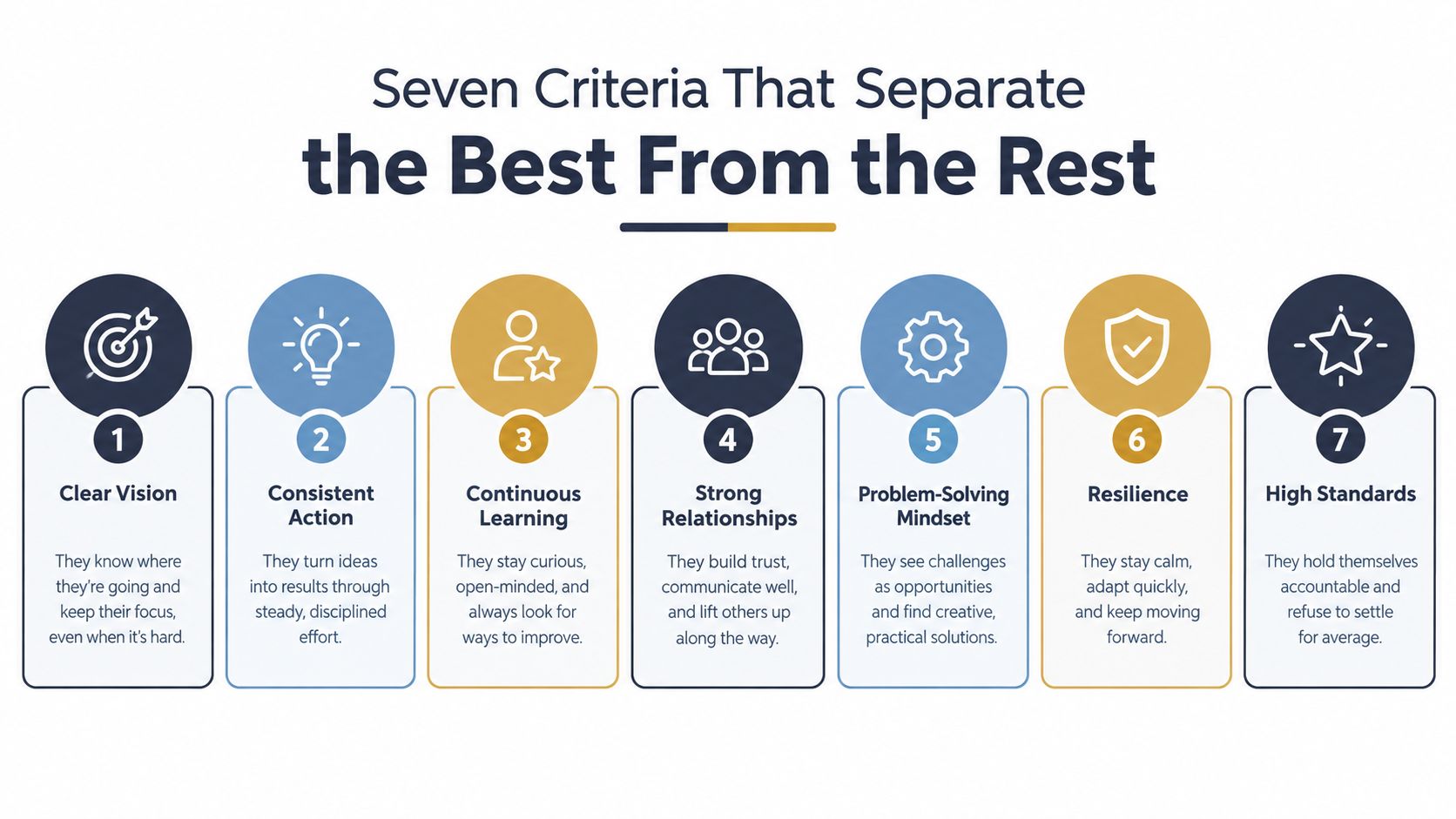
Seven Criteria That Separate the Best From the Rest
Most provider demos sound polished. Production performance comes from the details below, not from how friendly the sample voice sounds.
1. Answer rate
Ask for the provider's measured answer rate under normal conditions and during spikes. A service that misses calls itself defeats the reason you bought it. The plan requirement of 95% or better should be treated as an internal buying threshold, not as an industry statistic.
2. Speed to pickup
A caller shouldn't wait through several rings before deciding the business is unavailable. Fast response also protects lead value. Conversion-timing research reports that leads contacted within 5 minutes are 21 times more likely to convert than leads contacted after 30 minutes, as detailed in this lead response timing analysis.
3. After-hours coverage
Choose coverage based on when your customers call, not when your office closes. Evening, weekend, holiday, and emergency routing should be separate settings, with different instructions for routine requests and urgent jobs.
4. Language coverage
A multilingual promise only matters if the system can detect the caller's language, understand the request, and escalate accurately. Start with the languages your customers use. Guidance for small businesses recommends reviewing the last 90 days of customer conversations and beginning with the top 2 to 3 languages, rather than buying an oversized language list. Read the multilingual support rollout guidance before configuring your scripts.
5. Integrations
Your answering service should write into the tools your team already uses, including the calendar, CRM, helpdesk, or field-service system. If staff must copy every call summary by hand, you've created a new administrative queue.
6. Escalation rules
Define who receives calls based on intent, urgency, location, time, and customer type. A routine pricing question can become a message. An emergency repair, sensitive patient issue, or qualified legal enquiry needs a clear human path.
7. Pricing transparency
Compare the actual billing unit. Per-minute, per-call, included-volume, overage, and bundled plans produce very different totals. Use this practical guide to answering service costs to model your own call patterns.
Weight the criteria against call volume and average job value. A clinic may pay more for compliant human escalation. A solo electrician may prioritize instant pickup and after-hours dispatch. Don't shortlist providers until you've written those priorities down.
Comparing the Three Main Service Models
There are three sensible ways to staff the phone. Each solves a different part of the triage problem.
| Model | Cost per call/min | 24/7 coverage | Language support | Best for |
|---|---|---|---|---|
| Human live answering | Often priced per minute or call, with human staffing costs built in | Available through selected plans, but coverage depth varies | Strong when the provider has trained multilingual staff | Complex intake, sensitive conversations, and premium customer experience |
| AI phone assistant | Usage-based or subscription pricing, usually lower than continuous human coverage | Well suited to continuous coverage and concurrent calls | Broad potential, but quality must be tested in your customers' languages | High-volume routine enquiries, trades, bookings, and overflow |
| Hybrid routing | Combines automated handling with human escalation | AI covers routine demand while people handle exceptions | Can combine automated language detection with human support | Clinics, legal services, and businesses with mixed call complexity |
Human live answering
Human agents deliver the strongest empathy and improvisation. They can handle an anxious patient, a frustrated customer, or a complicated explanation without forcing the caller through a rigid decision tree. The trade-off is cost, staffing availability, and inconsistent coverage outside staffed periods. Human services can also become expensive when every routine question consumes agent time.
AI phone assistants
AI answers consistently, handles concurrent demand, and can manage repetitive questions, qualification, and scheduling without waiting for a receptionist. A vendor-reported benchmark describes 80% of requests handled automatically in under 60 seconds, 24/7, with replies in more than 30 languages. Treat that figure as directional vendor evidence, not an industry-wide standard, as explained in this AI customer service workflow.
The weakness is nuance. AI can misunderstand an unusual request, mishandle an emotional caller, or follow an incomplete business rule too rigidly. You need tested scripts, clear boundaries, and a human escalation path.
Hybrid setups
Hybrid is the practical middle ground. AI handles the volume and filters intent. Humans take the calls that involve judgment, risk, emotion, or substantial commercial value. This approach usually fits clinics, professional services, and growing businesses that want immediate pickup without removing people from sensitive workflows. The distinctions between these operating models are covered in this guide to answering services, virtual receptionists, and AI.
My recommendation is direct. High-volume trades and clinics should start with AI or hybrid coverage. Legal, medical, and luxury hospitality businesses should retain a human layer for complex intake. Solopreneurs with low volume can begin with pay-as-you-go human coverage, then add automation when routine calls start consuming working time.
Top Call Answering Services Worth Considering
The right shortlist depends on the model you want, not on a generic ranking. Human-first services suit businesses where caller emotion and nuance dominate. AI-first services suit businesses where speed, availability, and repeatable workflows matter more.
| Provider | Model | Starting Price | 24/7 Coverage | Best For |
|---|---|---|---|---|
| National human live-answering provider | Human | Roughly $0.85 to $1.50 per call or $250 to $500 monthly plans | Available on selected tiers | Businesses that prioritize warm handling |
| Mid-market virtual receptionist | Human or hybrid | Roughly $300 to $700 monthly | Depends on plan | Clinics and professional services needing structured intake |
| US-focused 24/7 operation | Human | Custom or volume-based | Yes, for selected operations | HVAC, plumbing, and dental groups |
| Established AI receptionist | AI | Usage or subscription based | Designed for continuous coverage | Appointment-heavy small businesses |
| fonea | AI-first | Around $0.10 to $0.20 per call or $39 to $99 monthly tiers | Yes | Trades, freelancers, and SMBs needing multilingual automation |
Human live-answering providers
A national live-answering brand is the safest choice when every caller needs a person. The usual strengths are warm greetings, flexible message taking, and better handling of complicated conversations. The weaknesses are familiar: limited after-hours depth, higher usage costs, and integration gaps that can leave staff re-entering call details.
Best for: professional businesses where the human tone is part of the service being sold.
Mid-market virtual receptionists
A virtual receptionist firm typically gives you lead-intake scripts, appointment handling, and bilingual support at a more structured price point. Plans often sit around $300 to $700 per month, while per-minute overage charges can punish longer calls. Review what happens after the included allowance, especially if callers tend to explain technical or medical issues at length.
Best for: multi-location clinics and professional services that need people involved but don't want a receptionist at every site.
US-focused 24/7 operations
A US-focused answering operation makes sense when the call must reach a trained person at any hour. Trades and medical offices benefit from clear dispatch notes, urgent-call rules, and round-the-clock intake. The trade-off is that human coverage costs more and may still require manual entry into calendars or field-service systems.
Best for: HVAC, plumbing, dental, and other organizations where the caller needs immediate reassurance from a person.
AI-first services
AI-first platforms compete on instant pickup, concurrent call handling, multilingual routing, calendar actions, CRM logging, and usage-based pricing. Routine questions can be automated, while urgent requests go to a human. The buyer's job is to test real conversations, including accents, interruptions, ambiguous requests, rescheduling, and escalation.
fonea offers a natural-voice AI phone assistant with after-hours coverage, language detection, appointment booking, routine question handling, lead qualification, human escalation, calendar and CRM connections, and email or optional SMS summaries. Its stated language support includes English, Spanish, French, German, and Italian, with transparent usage-based plans.
Best for: tradespeople, freelancers, and SMBs that need constant availability without paying human staff to answer every routine call.
Don't choose from a pricing card alone. Run the same call scenarios through each shortlisted service and inspect the record created afterward. If the booking is wrong, the urgency is misclassified, or the CRM entry is incomplete, a low monthly price won't save the workflow.
Why AI Is Now Good Enough to Lead the Call
For most small and mid-sized businesses, AI should be the first line of phone coverage, not because it replaces every receptionist, but because it handles the two failures humans struggle to prevent: delay and limited availability.
Lead response research reports that contacting a lead within 5 minutes makes that lead 21 times more likely to convert than contact after 30 minutes. An AI receptionist can answer immediately, collect the caller's intent, and start booking or routing while the opportunity is still active. The practical value isn't a futuristic conversation. It's preventing a high-intent caller from becoming an unrecorded voicemail.
Routine work is the right place to start
Scheduling, opening hours, addresses, service-area questions, basic qualification, and intake collection follow repeatable patterns. A vendor source reports that 80% of requests can be handled automatically in under 60 seconds, around the clock, with multilingual replies. That's a useful directional proof point for designing an automated first layer, not a promise that every business will reach the same result.
People should spend their attention on exceptions. Emotional complaints, sensitive medical situations, end-of-life conversations, disputed charges, and unusual legal or operational questions need a clean handoff. The AI should recognize those boundaries, summarize the conversation, and transfer the caller without making them repeat the story.
The best implementation starts small. Connect the AI to the calendar, load the most common questions, define emergency rules, and keep human review for bookings and escalations. Test multilingual calls using the languages customers speak, then examine resolution quality rather than judging the system by voice realism alone.
AI handles volume and speed. Humans handle judgment and exceptions. The caller shouldn't feel abandoned during the handoff, and staff shouldn't receive a transfer without context. That complement-human workflow is the standard to demand from an AI answering service.
Matching the Right Service to Your Business
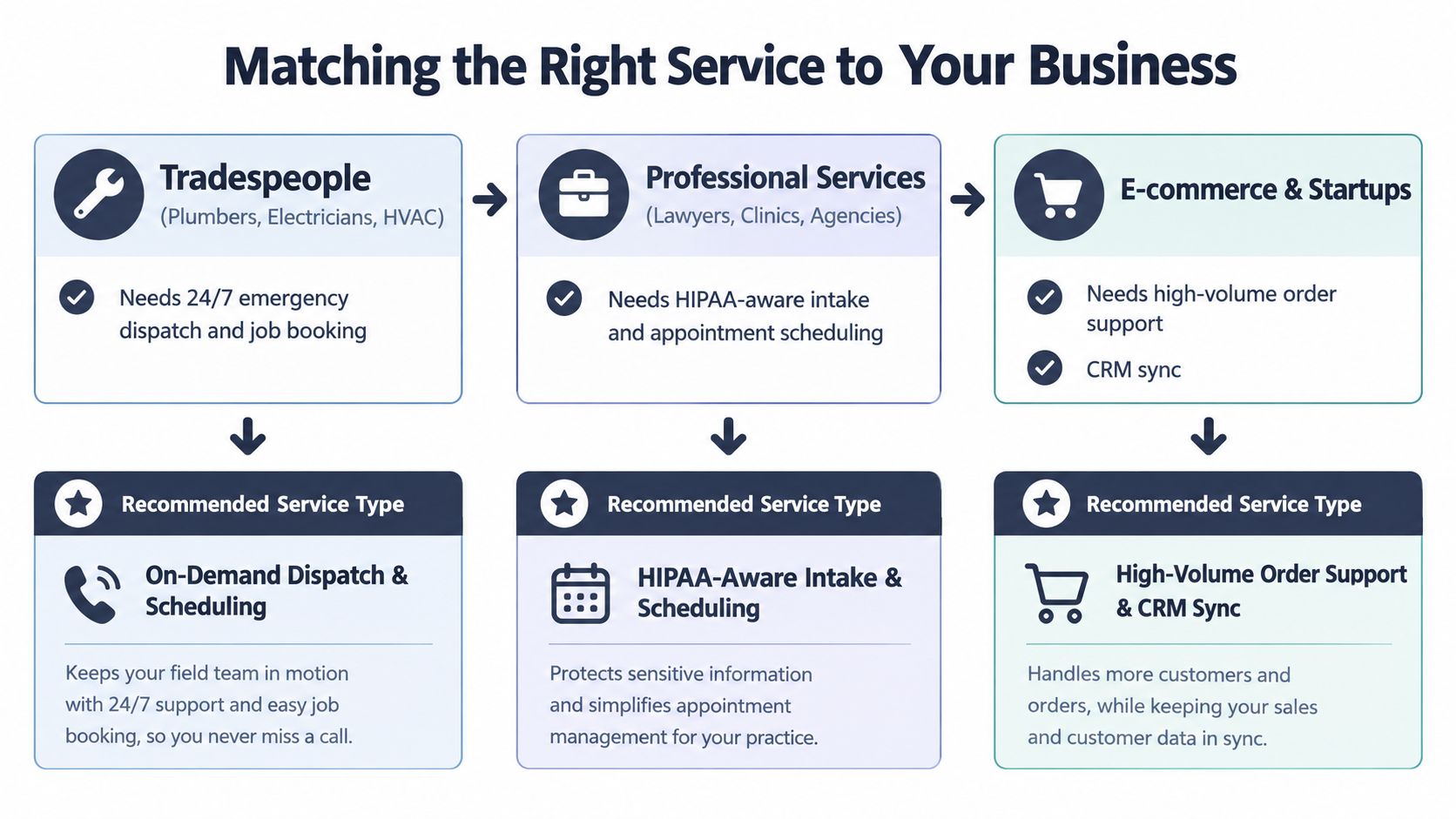
Use the caller profile, not the industry label, to choose your setup. A plumber and a large clinic may both need 24/7 answering, but they don't need the same escalation rules.
| Buyer profile | Recommended service | Three must-have features |
|---|---|---|
| Tradespeople, including plumbers, electricians, and HVAC companies | AI-first, with live dispatch for urgent work | After-hours emergency capture, job booking, rapid dispatch notes |
| Multi-location clinics, including dental, med-spa, and veterinary practices | Hybrid or human-first | Appointment booking, bilingual intake, HIPAA-aware message handling |
| Solo freelancers and consultants | AI-first or pay-as-you-go coverage | Call screening, voicemail-to-text, professional greeting |
Use the cost of a missed call as the filter
If a missed call costs you more than $150 and you miss more than five calls a week, go AI-first. If more than a quarter of calls involve emotional or complex triage, keep a human layer. If you operate multiple locations with different hours, prioritize centralized routing and per-location analytics.
Those rules prevent a common buying mistake. Businesses often pay for human coverage everywhere when only a small share of calls needs human judgment. The better design sends routine demand to automation and reserves people for conversations where their skills affect trust or revenue.
Roll out the service without disrupting customers
1. Pilot overflow only for two weeks. Keep your current phone process in place and forward calls when staff are busy. 2. Instrument outcomes. Track answered rate, booking rate, callback time, qualification quality, and after-hours capture. 3. Expand to after-hours. Once the scripts and escalation paths work, cover evenings, weekends, and holidays. 4. Retire voicemail. Remove the fallback that creates delay and gives staff no structured information.
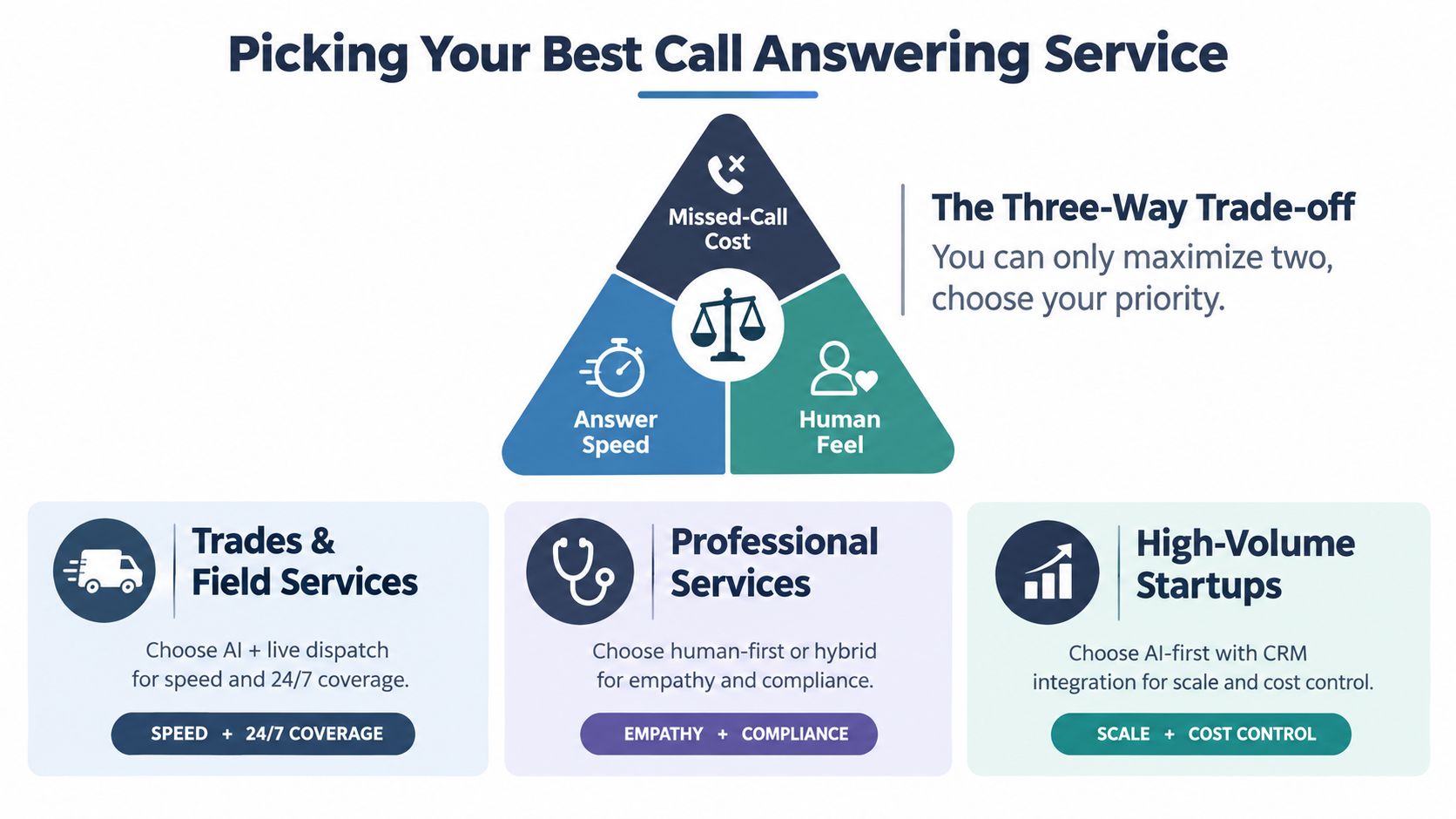
Privacy, integration, and testing deserve the same attention as conversation quality. Deployment guidance recommends checking CRM and helpdesk compatibility, reviewing security and GDPR obligations, and testing translation quality in real workflows. Use this trade-off diagram as a reminder that your choice sits between missed-call cost, answer speed, and human feel.
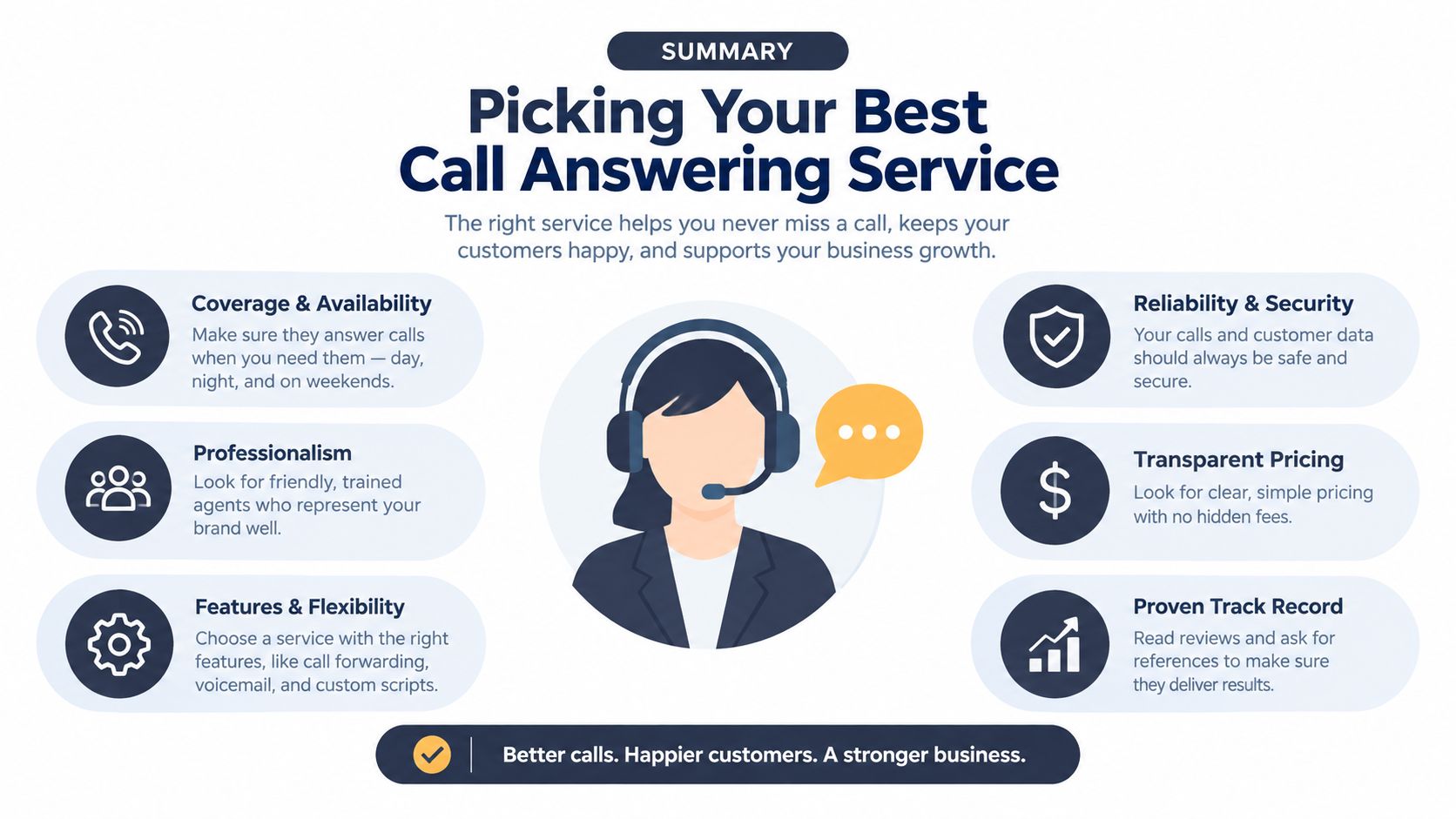
Picking Your Best Call Answering Service
The decision comes down to three competing priorities. Human receptionists maximize empathy, AI maximizes speed and availability, and your budget determines how much coverage you can sustain.
For tradespeople, solo freelancers, and most SMBs, start with AI-first answering. You need calls picked up quickly, routine questions resolved, appointments booked, and urgent jobs escalated. Clinics with sensitive intake should use a hybrid or human-first model, particularly when language, privacy, and emotional context affect the interaction.
Virtual receptionist firms can work well for multi-location practices that need bilingual staff and more structured intake. AI-first platforms such as fonea fit businesses that want multilingual routing, appointment and CRM workflows, continuous coverage, and usage-based billing without staffing every call.
The best call answering service doesn't maximize every feature. It matches coverage to caller intent and avoids paying human rates for routine work. Start with overflow, measure answer rate, lead capture, booking rate, and after-hours coverage, then expand only when the workflow proves itself.
--- fonea provides 24/7 AI call answering, multilingual conversations, appointment booking, lead qualification, CRM and calendar connections, and escalation for calls that need a person. Visit fonea to arrange a demo or start a trial, then compare it with your current setup using answer rate, lead capture, and after-hours coverage as your decision metrics.
Try fonea, no strings attached
AI phone assistant for business. Hear a live demo in your browser, book a call with our team, or get started — from £90/month, cancel monthly, no minimum term.
GDPR-compliant · EU & UK GDPR · Multilingual